so many paintings, so little time

NACHBARN/Neighbors in a German Town

In New Exhibitions on January 28, 2016 at 8:15 am


Carlebach2lo-res

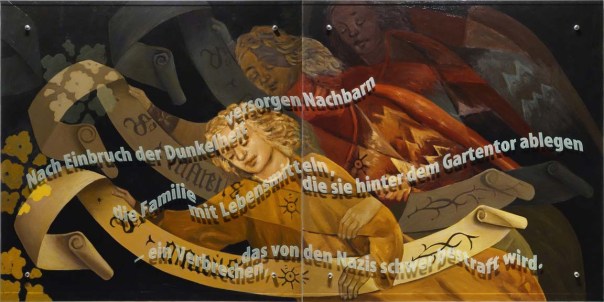
Carlebach Küchentuch #2, 2015, oil/linen mounted on wood panel, sandblasted glass, bolts, 100cm x 200cm (Translation: “After dark, anonymous neighbors secretly leave the Jewish family baskets of groceries inside their garden gate, considered a serious crime by the Nazis.)

                                                                                    .

An Exhibition of Paintings, Silverpoint Drawings, and Video by Ken Aptekar

St. Annen Museum, Lübeck, Germany 
7 February 2016—29 May 2016  #nachbarnkunst  #neighborsart
                                                                                        .
Jews have lived alongside Christians in Lübeck, Germany, since 1350. Their neighbors now include Turkish Muslims as well. The synagogue in Lübeck, built in 1880, is one of the few left standing after Kristallnacht. Just next door to it on the walls of the St. Annen Museum hangs a glittering collection of Renaissance altarpieces. Within walking distance of the Museum and the synagogue are three Mosques. This is the nexus in which Nachbarn/Neighbors unfolds.
NachbarnGallery5-IV2

Installation View, Nachbarn/Neighbors, 2016, Kunsthalle St. Annen, Lübeck, Germany

After recent tragic events in Paris, and the ferocity of anti-immigrant hatred in Europe and the US, now is the right moment to propose, envision, and cultivate empathy and communication across cultural differences.
During the Nazi years what happened to neighbors in Lübeck who happened to be Jewish is well known. But in the years before the rise of Hitler, Jews flourished there.
Synagoge_01

Synagogue, Lübeck, built in 1880; to the left is the social services building for the Jewish community

                                                                                      .
A rabbinical dynasty began with Salomon Carlebach, the rabbi of the Lübeck synagogue from 1870-1919. A grandson of Salomon, Shlomo Carlebach, later became internationally well-known as New York’s Singing Rabbi. Beginning in the 1990’s Russian Jewish immigrants began to replace the once vibrant community that was destroyed in the war. With the onset of terror attacks on the synagogue in 1994, and in 1995, 2005, and 2012, a 24-hour police guard house was erected next to it along the eastern wall of the St. Annen Museum.
1_IThoughWeWereFriendslo-res

I Thought We Were Friends, 2015, oil/linen mounted on wood panel, sandblasted glass, bolts, 100cm x 100cm

.

When confronted with this history, I wondered if young Christian Germans in Lübeck today think about why their relatives closed the curtains as the Nazis came to pick up the Jews next door. And what are Lübeckers’ attitudes toward Muslims—and the Russian Jews now living in Lübeck? Can people recognize and respect their profound differences and together build a vibrant community? And what can Christian paintings from long ago, some with anti-Semitic imagery, possibly have to say to Jews, and Muslims, not to mention Christians today?

artforum drawing sm

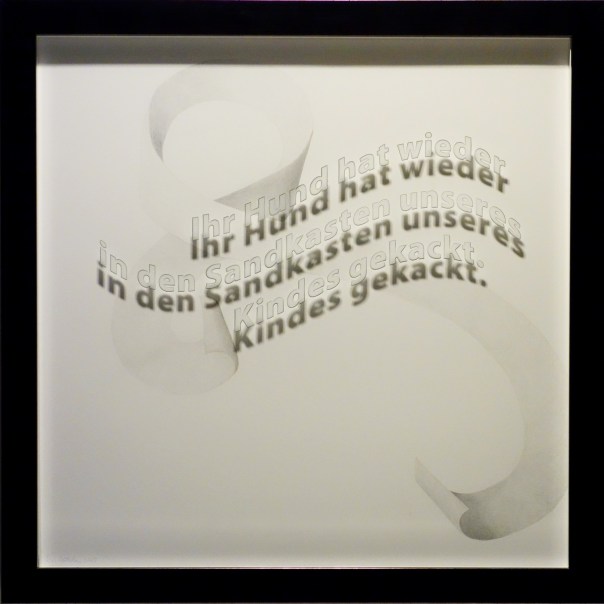
Ihr Hund hat Wieder [Translation: “Your dog shit again in my kid’s sandbox.”], 2015, 60cm x 60cm, silverpoint on clay-coated paper, sandblasted glass, framed

                                                                                      .
Other elements from which this exhibition evolved include
  • a long-lost monogrammed kitchen towel that fifty years after the end of WWII reconnected neighboring families, Christian and Jewish, and came to symbolize courage and humanity in a town seized by fear and hatred
  • the race against the clock to find the last surviving pre-WWII Bar Mitzvah boy from the Lübeck Synagogue, whose family fled in 1937 to South America
  • this American artist’s determination to broaden the narrative of the tragic victimization of Jews in Nazi Germany, to take on otherness, immigration and community, to speak to new generations in Lübeck and elsewhere

Inspired by a museum of Christian Art and the Jewish and Muslim communities in this German town, Nachbarn invites new viewers and old paintings to speak to each other. All the works in the exhibition are based upon altarpieces in the museum collection. With works that merge my two identities, Jew and painter, I aim to dissolve persistent boundaries between people. As the philosopher Emmanuel Levinas wrote, “My relationship with the Other as neighbor gives meaning to my relations with all the others.”  [Emmanuel Levinas, Autrement qu’être ou au-delà de l’essence (Otherwise than Being or Beyond Essence), 1984].

Hofmann_Video_Stillslo-res

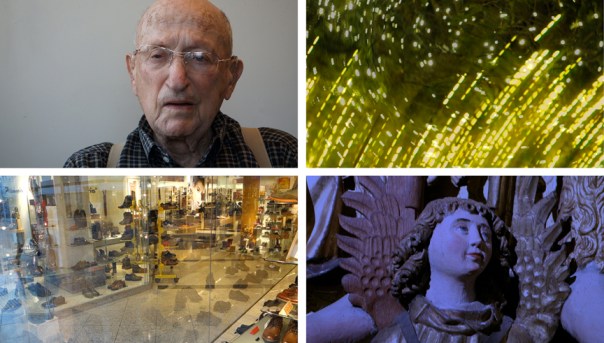
Stills from Video, Die Flüchtling Aus Lübeck, (“The Refugee from Lübeck) 2016, 10 minutes 38 seconds

                                                                                         .
“Die Flüchtling aus Lübeck” (The Refugee from Lübeck), a video I taped in Santiago, Chile, recounts the Jewish experience of Lübecker Rodolfo Hofmann in 1936. Nachbarn is my first exhibition in Germany.
                                                                                         .
Following the opening of the exhibition, French psychoanalyst Chantal Maillet wrote an elegant essay that captures the essence of the project from an odd and unpredictable angle: Broken Glass. The writer Caroline Brothers noted that “the most extraordinary symbolism of Chantal Maillet’s story is its echoes, over all the intervening decades, of a Kristallnacht reversed.” You can find it HERE.
                                                                                          .
A catalogue is available with essays by Dr. Janet Wolff, Professor Emerita of Cultural Sociology, University of Manchester, UK; Dr. Ernst van AlphenProfessor of Literary Studies and Holocaust Studies at the University of Leiden, The Netherlands; and Dr. Thorsten Rodiek, Director of the St. Annen Museum, Lübeck.
                                                                                           .
NachbarnGuardianforWebsite
                                                                                       .
                                                                                        .
                                                                                         .
                                                                                         .


Mme de Pompadour: More than a Patron?

In Uncategorized on June 27, 2015 at 2:01 am
4850992261_ff4293419e

Madame de Pompadour (detail), 1750, Francois Boucher, Collection Harvard Art Museums

A good moment now to pay a visit to Madame de Pompadour with the publication of Women Artists: A Linda Nochlin Reader, edited by Maura Reilly and the attention to women artists in, for example, ArtNews.

Mme de Pompadour, though not herself an artist in the strictest sense, made the art of France in the 18th century her own. She was the most powerful woman of her time, more influential even than the Queen of France whose husband, Louis XV, she loved for twenty years. Her role as a patron of the arts helped produce a golden age of French decorative and fine arts. Today the prodigious number of artworks she commissioned fill museums the world over. Yet credit for her savvy artistic choices has been buried under the style known as “Louis XV.”

style-louis-xv

Drawing on the rich art and history of 18th century France, I made a series of paintings with texts engraved on glass that take viewers into the glittering rococo world of the court of Versailles. A fortune teller, Madame Lebon, told the nine-year-old Jeanne-Antoinette Poisson that she would one day become the King’s lover. Fifteen years later, three years after she had married Charles-Guillaume Le Normant d’Etioles at age 20, the King paid off her husband and moved her into the Palace of Versailles. For twenty years she remained there with the King. Or in numerous palatial homes she built or redesigned for them, including today’s Presidential residence in Paris. My introduction of French and Yiddish texts in this work, along with English, revives Mme de Pompadour’s 18th century life for today’s multi-ethnic, multicultural world.

30

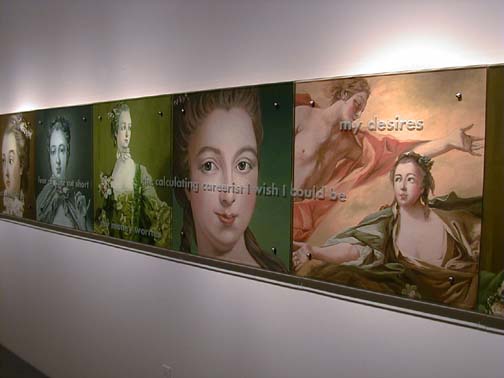
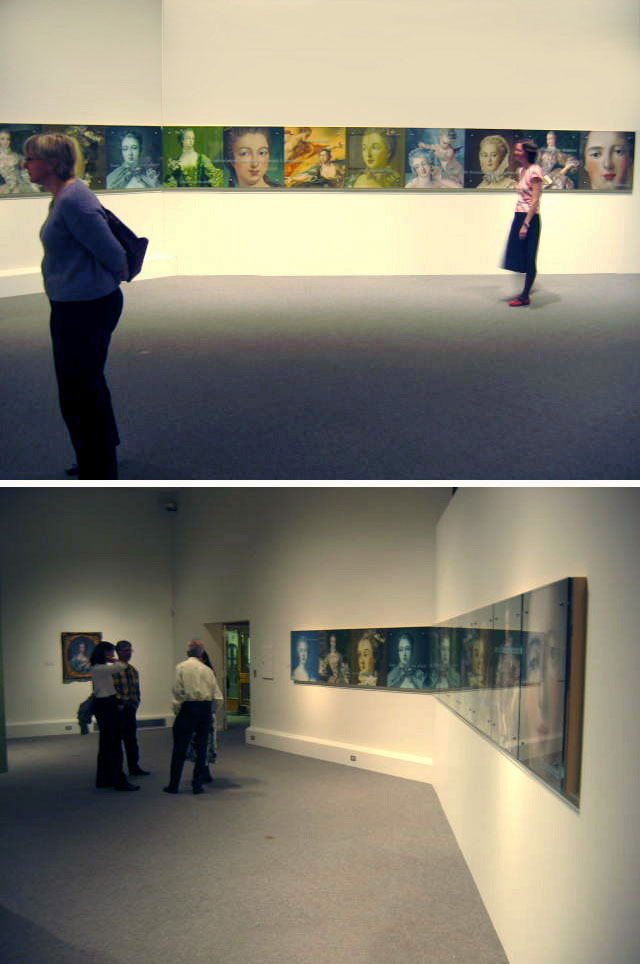
Ken Aptekar, Reflections, 2003, 30″ x 360″ Twelve panels, oil/wood, sandblasted glass, bolts
TEXT IN GLASS: my dependence, the wrong past, what I could not do, fear of a life cut short, my money worries, the calculating careerist I wish I could be, my desires, my passivity, dearest sister, neither Russian nor a Grandmother, nor a Yiddishe mama, my beloved
After (l to r) Jean-Marc Nattier, Madame de Pompadour as Diana, 1748
Francois Boucher, Madame de Pompadour, 1759
Francois Boucher, Portrait of Madame de Pompadour Standing, c. 1750
Francois Boucher, Madame de Pompadour at her toilette, 1758
Francois Boucher, Madame de Pompadour, c.1750
Francois Boucher, Apollo and Issa, 1750
Francois Boucher, Madame de Pompadour, 1756
Francois Boucher, The Toilette of Venus, 1751
Francois-Hubert Drouais, Madame de Pompadour with a Fur Muff, 1763
Francois Boucher, Madame de Pompadour seated outside, 1758
Jean-Marc Nattier, Madame de Pompadour as Diana, 1748

Reflections-detail

Reflections, detail (installation view)

ReedPompView

Reflections, Installation View at Reed College in Ken Aptekar: A Personal Public

For an exhibition about Pompadour at Reed College, “Ken Aptekar: A Personal Public,” I produced a video. “Three Acts” is a chronicle of my transformation into King Louis XV and then Mme de Pompadour at the hands of a Parisian make-up artist/stylist, Pierre Marie Humeau. Videotaped in Paris and in the private apartments of Louis XV and Pompadour in the Chateau de Versailles, Three Acts premiered in 2004 at Reed College. It was shown at Espace d’Art Contemporain Camille Lambert, Juvisy, France, in 2005, and at the Beard & Weil Galleries at Wheaton College, Norton, MA, in 2012.

Besides the video, I added paintings related to Pompadour for the exhibition at Espace d’Art Contemporaine Camille Lambert, in Juvisy, France, in 2005: La Chasse Humaine.  (For those with patience for my French, here is a video interview about that exhibition, by David Vielotte.) And in 2006-7 my Pompadour work was shown in at the Musée Robert Dubois-Corneau, in Brunoy, France.

A brief timeline of Madame de Pompadour’s life:

1721    Birth of Jeanne-Antoinette Poisson in Paris

1725    Marriage of Louis XV, King of France, to Marie Leszczynska (1703-1768)

1727    Flight out of France of François Poisson, father of Jeanne-Antoinette, to avoid prosecution for fraud, and Birth of Abel-François Poisson, brother of Jeanne-Antoinette

1741    Marriage of Jeanne-Antoinette to Charles-Guillaume Lenormant de Tournehem, the nephew of her mother’s lover (March 9) and Birth of Jeanne-Antoinette’s son who dies in his first year (December 26)

1744    Birth of Jeanne-Antoinette’s daughter, Alexandrine

1745    Start of affair between Jeanne-Antoinette and Louis XV following masked ball at Versailles, and Purchase by Louis of marquisate of Pompadour for Jeanne-Antoinette. Louis pays off her husband, Jeanne-Antoinette becomes Madame de Pompadour, and she moves into Versailles, where she later introduces the cultivation of flowers for bouquets to decorate her apartment. Offers bouquets to Queen for her apartment.

1749     Madame de Pompadour sends her brother on study tour of Italy with architect, artist, and abbé

1750     End of sexual relationship between Louis XV and Mme de P

1751     Brother of Mme de P becomes director of buildings to King, takes title of Marquis de Marigny, and Publication of first volumes of Diderot and d’Alembert’s Encyclopedia with support of Mme de P

1754     Death of daughter Alexandrine, age 10

1764    Death of Madame de Pompadour, Versailles, age 42

Ken Aptekar, Some for me, some for you, 60

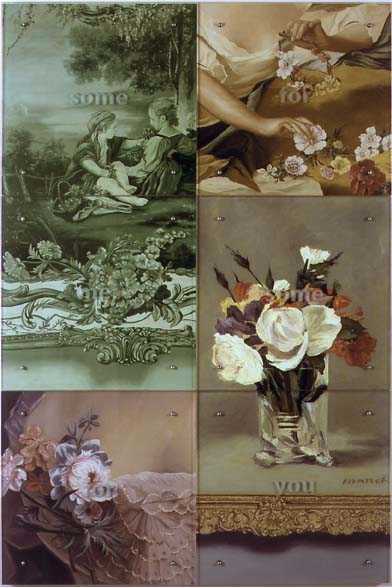
Ken Aptekar, 2003, Some for me, some for you, 60″ x 90″ six panels, oil/wood, sandblasted glass, bolts
After (clockwise, from upper left) Francois Boucher, “La Chasse ˆ l’oiseau et L’Horticulture” (Bird Hunting and Horticulture), Ornamental Panel Painting, c. 1751-1755
Jean-Marc Nattier, Madame Henriette en Flore” (Madame Henriette in Flowers), 1742
Edouard Manet, Still Life, c. 1882
Jean-Marc Nattier, Portrait of Manon Balletti, 1757
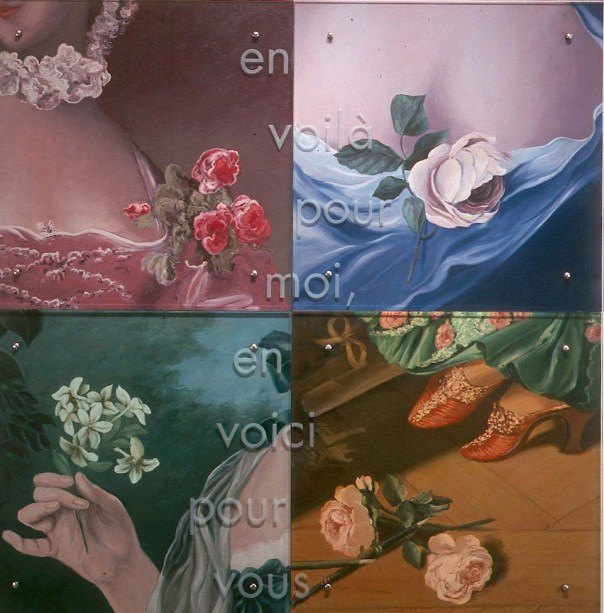
Ken Aptekar, 2003, En voila pour moi, en voici pour vous (

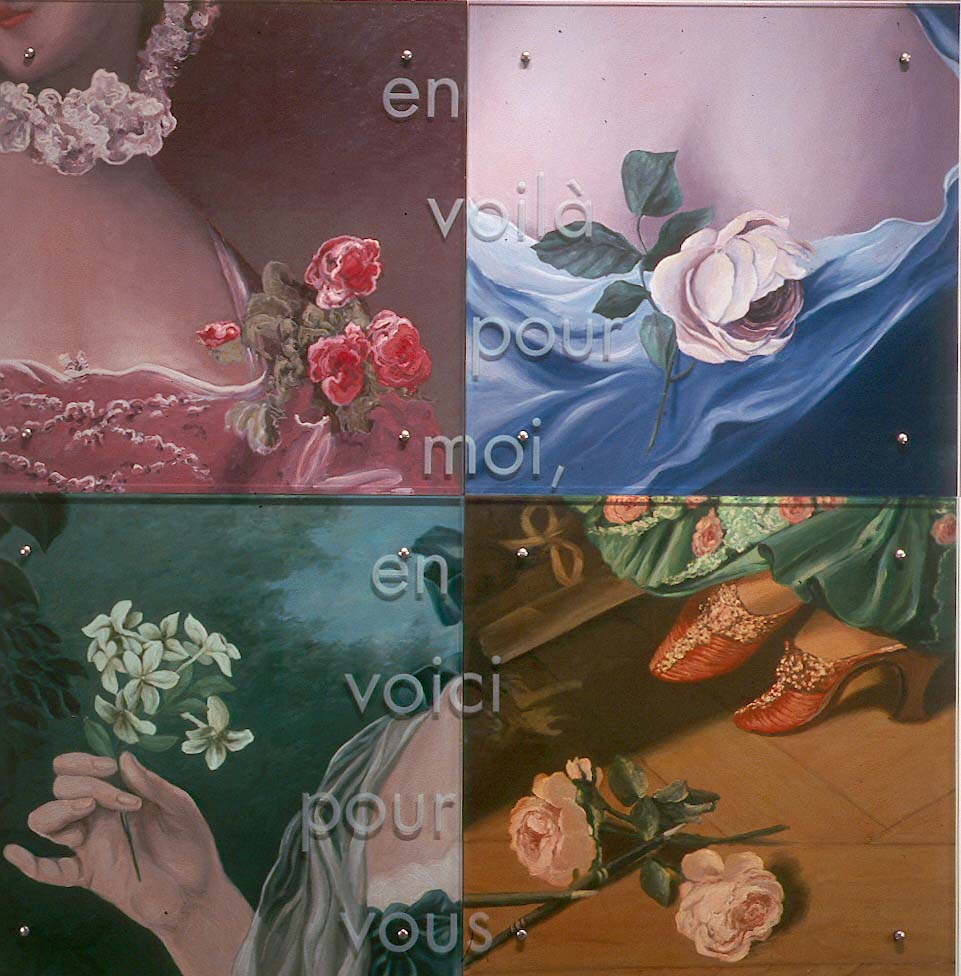
Ken Aptekar, 2003, En voila pour moi, en voici pour vous (“Some for me, some for you”), 60″ x 60″ (153cm x 153cm), oil/wood, sandblasted glass, bolts
After details of three portraits of Mme de Pompadour by
Francois Boucher and Carl van Loo, and a portrait of Manon Balletti
by Jean-Marc Nattier (upper-right)

Ken Aptekar, A bisl far mir, a bisl far dir, 2003, 60

Ken Aptekar, A bisl far mir, a bisl far dir, 2003, 60″ x 30″ (153cm x 76.5cm), diptych, oil/wood, sandblasted glass, bolts
Text IN GLASS: A bisl far mir, a bisl far dir [tr.: Some for me, some for you]
After Francois Boucher, “Les Genies des Arts” [tr.: Geniuses of the Arts], 1761
“A bisl far mir, a bisl far dir” refers to Mme de Pompadour commissioning art to please herself
as well as the King as well as herself, and also to my using previous art–for you and for me.
One can see in the image that the putti is making a painting of a sculpture, and Boucher has painted a painting-in-progress in his painting as well. The painting in progress behind the putti’s is of Madame de Pompadour holding a profile portrait of Louis XV. The Yiddish provides a means of declaring the relevance of 18th French art for those of us for whom it was never intended (Jews in Poland, for one example–Pompadour’s “competition” for the King’s attention was a Polish girl, Queen Marie Leszinska).

Ken Aptekar, She was decorating, 2003, 60

Ken Aptekar, She was decorating, 2003, 60″ x 60″ (153cm x 153cm), four panels, oil/wood, sandblasted glass, bolts 
After (l) Francois Boucher, The Bath of Venus, 1751, National Gallery of Art, Washington, (r) Francois Boucher, The Toilette of Venus, 1751, Metropolitan Museum of Art, NY
“She was decorating” is based on two images Mme de Pompadour commissioned from Francois Boucher for her bathroom at the Chateau de Bellevue (now destroyed), one of the many homes she built or decorated for herself and to encourage Louis to visit. Distortion of the two images suggests the way the two works might have appeared when seen in the corner of the bathroom from a single vantage point.

Ken Aptekar, Scenario, 2003, 60

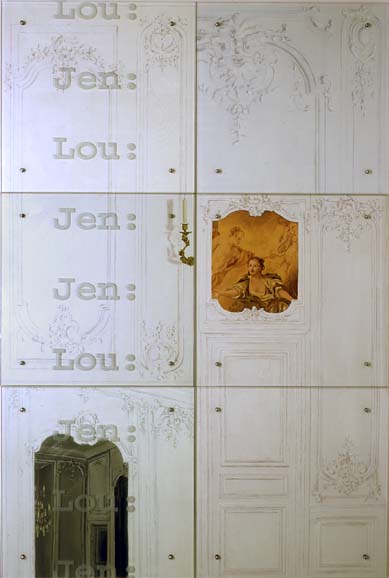
Ken Aptekar, Scenario, 2003, 60″ x 90″
six panels, oil/wood, sandblasted glass, bolts
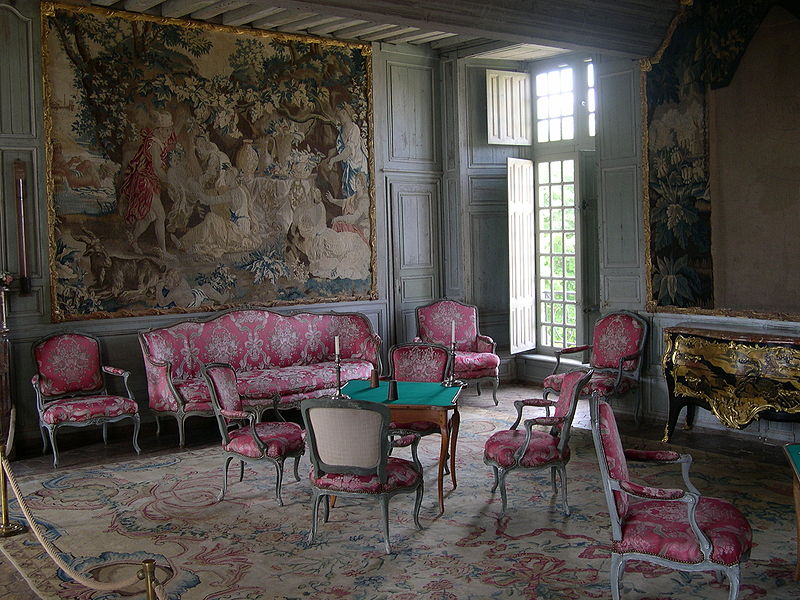
SCENARIO is comprised of images of the walls of Mme de Pompadour’s private apartment in the Chateau de Versailles, to which Louis XV had a secret staircase built leading from his private apartment below. The painted image on the wall (not the mirror) is a detail of a Boucher mythological painting, APOLLO AND ISSA, in which he used Mme de Pompadour’s face for the character of Issa. Jen refers to Jeanne-Antoinette Poisson, Mme de Pompadour’s birth name; Lou is short for Louis. “Scenario” is “screenplay” in French.
A Repainter Isn’t Necessarily a Painter

In Uncategorized on February 23, 2015 at 9:40 am
Interior View, Linn Underhill Studio, Lisle, NY, 2/22/2015

Interior View, Linn Underhill Studio, Lisle, NY, 2/22/2015

In photographer Linn Underhill’s studio this weekend I saw a new work pinned to the wall. Though I doubt that she had Jackson Pollock in mind when she made it,

Jackson Pollock, Number 31

Jackson Pollock, Number 31, 1950, MoMA, New York

I couldn’t help but think that her photo-based work elaborated upon Pollock’s iconic drip paintings in Underhill’s very personal and feminist way. Without ever setting brush to canvas, Underhill repainted Pollock, making a disturbing, haunting new work.

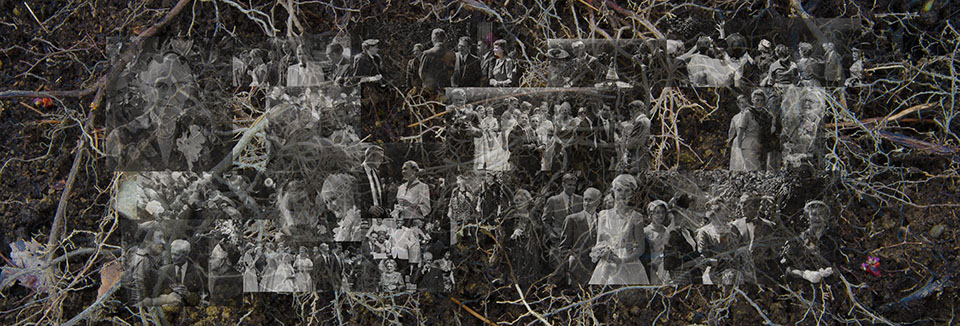
Underhill’s mother was a photographer too. She photographed many 1950’s weddings in northern California. Over the years Underhill has occasionally incorporated her mother’s photographic archive in surprising ways, for example, using wedding shots to give the lie to the “happiest day in a girl’s life.” Those forced smiles and stiff family groups sometimes can prefigure the profound disappointment and tragic melancholy that leads to lives of misery.

View out the back door of Linn Underhill's studio, Lisle, NY

View out the back door of Linn Underhill’s studio, Lisle, NY

Underhill trapped some of these wedding moments in the tangled bramble that she photographs in the woods out behind her studio in upstate New York to powerful effect.

Linn Underhill, Roots, 2015 (Archival Inkjet Print)

Linn Underhill, Roots, 2015 (Archival Inkjet Print)

Linn Underhill, Roots, 2015, DETAIL (archival inkjet print)

Linn Underhill, Roots, 2015, DETAIL (archival inkjet print)

More here on the work of Linn Underhill.